

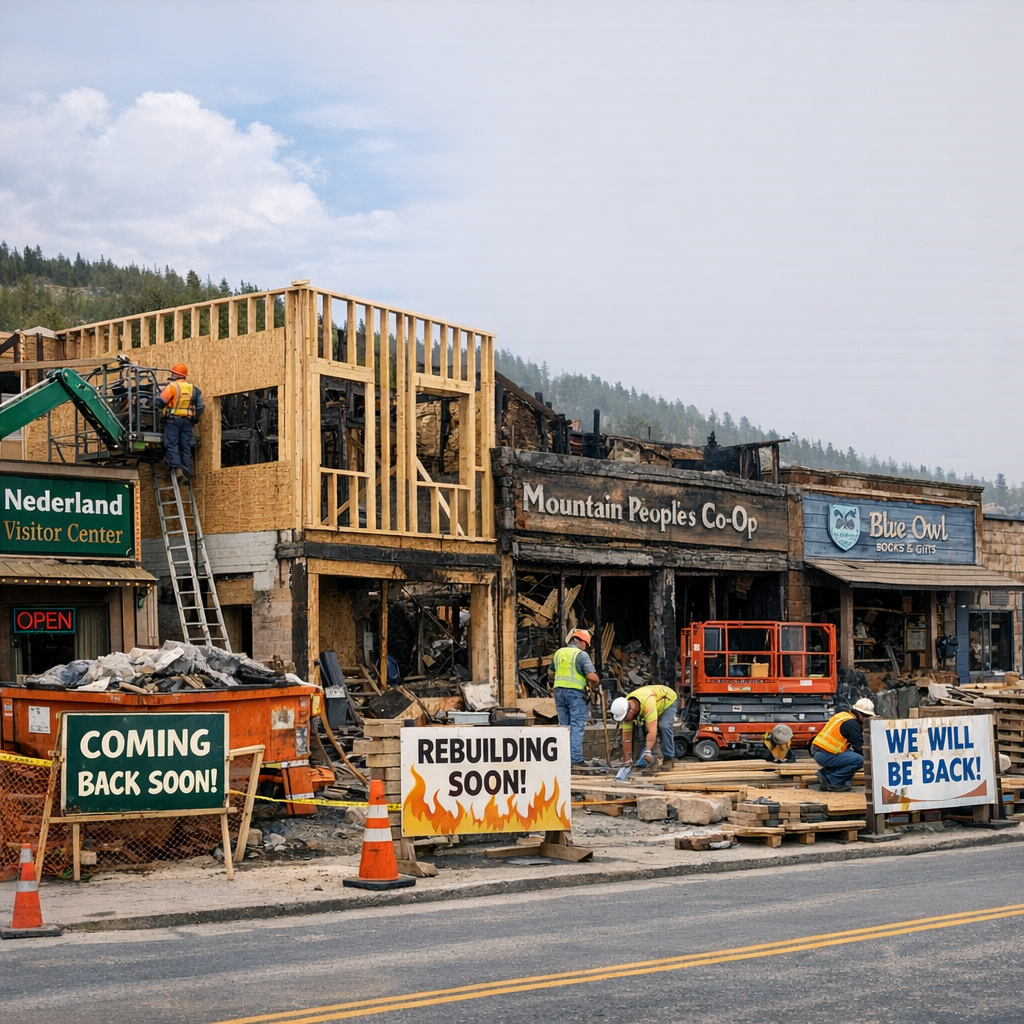
Nederland has long been known as a mountain town with outsized character—quirky, artsy, and close to both Boulder and the trailheads of the Front Range. But the October blaze at Caribou Village Shopping Center destroyed or damaged nearly one-third of the town’s businesses, and up to 30% of its sales tax revenue. As business owners assess losses, the community is also finding ways to rebuild. Below are economic trends, strengths, and potential paths forward for Nederland’s business sector.
Strengths Anchoring the Local Economy
Though Nederland’s permanent population hovers around 1,600 residents, its appeal extends well beyond town limits. Scenic trails, proximity to Eldora Mountain Resort, and a reputation for outdoor recreation bring in visitors from Boulder, Denver, and beyond—fueling spending at local shops and restaurants. Its downtown, prized for its charm and the creative flair of its arts community, provides a competitive edge many small mountain towns lack.
Beyond its tourism draw, Nederland’s economic data shows resilience: the town’s per-capita income is substantially higher than both the Boulder Metro Area and Colorado as a whole, and its poverty rate is impressively low. These factors mean local businesses may find more stable demand, especially for higher‐quality goods and services that cater to both residents and visitors.
Challenges and the Impact of the Fire
The Caribou Village fire didn’t just destroy buildings—it erased livelihoods. Nearly twenty businesses were destroyed outright and dozens more displaced, affecting austere arts, service-based enterprises, and small shops. The loss rippled through workers, business owners, and the town’s cultural fabric. Restoration efforts are ongoing, and several business owners have relocated to new temporary spaces even as damage assessments continue.
Nederland’s economic vulnerabilities—small population, expensive housing, limited commercial space—were well known even before this disaster. Aging infrastructure like sidewalks and buildings, and the lack of adequate light industrial or commercial space, make recovery harder. These structural constraints have made it difficult for certain essential business types to establish themselves here.
Opportunities for Rebuilding and Economic Growth
The fire has, for many, opened a window to reimagine downtown. Community fundraising has already raised sizable sums, and developers are converting older buildings like the old Citywide Bank into a mixed space called “The Vault” that will house several of the displaced businesses. This represents both recovery and an opportunity to upgrade infrastructure and improve foot traffic in downtown.
On a policy level, there’s room for more structured support—dedicated tourism budgets, stronger business community organizational capacity, and better online presence. Investments in housing affordability and increased commercial and light industrial space could help draw a more diverse set of enterprises and retain essential workers.
Working capital and technical assistance are also vital in times like this. The town has been coordinating with county and state resources to link affected businesses with rebuilding aid, insurance help, and training—efforts that could set precedents for disaster resilience in small mountain towns.
What the Business Community Can Do Now
- Collaborate: Local business owners, town staff, and nonprofits can coordinate special events to draw visitors, share marketing resources, and partner on downtown activation.
- Adapt spaces: Reuse or retrofit damaged commercial sites, and consider temporary locations to keep brands visible during reconstruction.
- Plan long term: Support for infrastructure upgrades—roads, sidewalks, utilities—can make downtown safer and more welcoming.
- Ensure housing and workforce tie into economic development: Affordable housing or worker housing could alleviate labor shortages and turnover.
- Leverage tourism while protecting character: Visitors are vital, but preserving the arts, supporting resident-oriented services, and keeping the town’s quirky identity matter.
Recovery after loss is rarely straightforward, but Nederland’s strengths—community pride, local creativity, tourism, and engaged governance—offer solid foundations. By combining immediate rebuilding with long-range economic planning, town and businesses alike can emerge more resilient and more vibrant.